
Objective data supports effective public policy / /
The nonprofit New Hampshire Fiscal Policy Institute (NHFPI) aims to provide unbiased information for state policymakers. Based in Concord, it has a staff of six, including long-time research director Phil Sletten, senior policy analyst Nicole Heller, and policy analyst Jess Williams.
 Gene Martin is NHFPI’s executive director. A self-described product of Manchester’s public school system, Martin previously worked as government relations director for Plymouth State University and a policy and communications staff member for the NH State Senate.
New Hampshire Children’s Health Foundation has provided support to NHFPI, most recently in the last two years to document the benefits of the State continuing to support expanded Medicaid eligibility so lower income families can access health benefits. A separate project provided data and analysis on food insecurity in the Granite State and the effectiveness of the SNAP (Supplemental Nutrition Assistance Program, formerly known as food stamps) in meeting the needs of low income residents.
When asked what role the Fiscal Policy Institute plays in state public policy and why it matters, Martin stated that the work the organization does is of heightened importance in New Hampshire for two reasons.
“First, our policymakers, meaning state legislators, are volunteers,” he said. “They’re getting paid a hundred dollars a year, and for the most part, they don’t have staff. So, a lot of our work is explaining issues and working with legislators. We don’t lobby. We’re an objective information source.”
“Second,” he continued, “When we say, ‘policymakers,’ we’re also talking about state employees. Our state agencies are lean. They don’t necessarily have a deep bench of policy staff who are able to provide legislators with data analysis and data visualization in a meaningful way.”
“New Hampshire Children’s Health Foundation has had a great research partner in NHFPI for more than ten years,” said Foundation program director Patti Baum. “Their excellent data analysis and communication has been a helpful support for policymakers, advocates and others who are working to create better access to health insurance coverage, federal nutrition programs, economic security and other issues of importance to New Hampshire residents.”
As Baum noted, the New Hampshire Fiscal Policy Institute has become a highly respected information source for state policymakers. As an example, 25% of the members of the state legislature attended one of its state budget webinar sessions during the last budget cycle. A bipartisan mix of policy makers were represented according to Martin.
When asked what the difference between the Fiscal Policy Institute and an advocacy organization is, Martin emphasized that the Institute lets the data speak for itself.
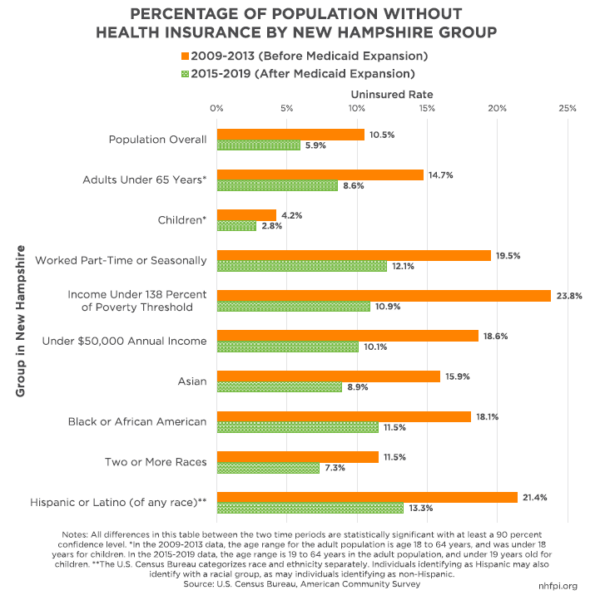 “The goal, for example, of the Medicaid expansion brief we produced, was to outline what the impacts of expanded access to the program had been and would be on real people,” Martin said. “We didn’t say the legislature should expand it or not.”
In the last year, the New Hampshire Children’s Health Foundation funded NHFPI work on poverty and food insecurity. Martin explained that the goal was to help policymakers understand the situation.
“Oftentimes, we hear or read about how New Hampshire has the lowest poverty in the nation,” he said. “That’s 100% true. But we also know that there are a hundred thousand Granite Staters who live in poverty.
“According to census survey data, we also know that in 2023, one-third of residents shared they are struggling to meet their monthly expenses,” he added.
“So, our goal is to not say you should do X, Y, or Z to affect that. Advocates like New Hampshire Hunger Solutions may use our data to do that, but we just want to let people know that hunger exists in the state and the communities where it’s likely to happen.”
Continuing the example, Martin explained that if the SNAP program seems underutilized, it’s clearly not because hungry people don’t exist in New Hampshire. The Institute provides the data on that, and advocacy groups may take that data and talk with policymakers about the challenges people have in accessing the program.
“While advocates tell the story of those New Hampshire residents who can benefit from SNAP, WIC and other nutrition programs,” Patti Baum added, “the data analysis by NHFPI provides concrete evidence and demonstrates the need to those who have the ability to improve access to these programs.”
Another concern in this area Martin noted is that NHFPI has started to see the poverty rate for seniors increase. “It’s very concerning,” he said. “Our data shows that many seniors are eligible for SNAP benefits, but they tend to have a low participation rate. And that’s not for a lack of need.”
“Your average person is not digging into the census data and into the details. That’s our job and we try to show what it means in a helpful way,” he said.
Maintaining objectivity
The New Hampshire Fiscal Policy Institute accepts support from organizations like the New Hampshire Children’s Health Foundation, but makes it clear that it will maintain full editorial control of the work.
“A funder cannot take a look at our work and then provide suggestions or edits,” Martin said. “We’re really clear that there’s a bright line.”
“Lawmakers and others rely on objective data analysis,” Baum said. “They want an unbiased account of what New Hampshire residents are experiencing, whether it relates to insurance access and coverage, nutrition program eligibility and other important health issues. NHFPI provides just that.”
Big challenge on the horizon
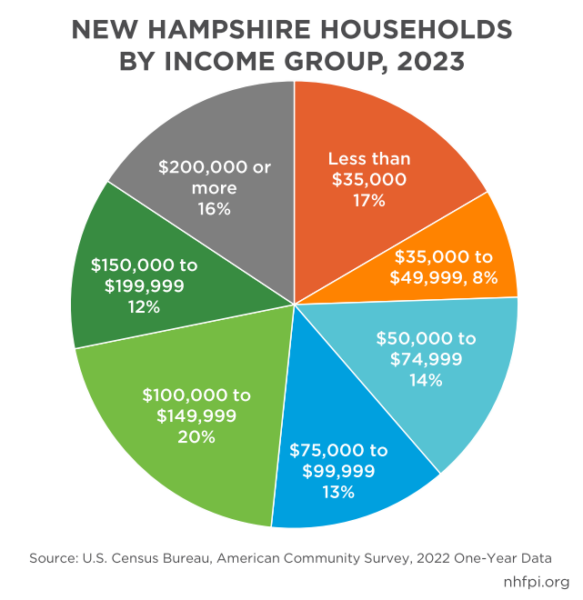 What does he see as the state’s biggest challenge on the horizon? “Economic security,” Martin responded matter-of-factly. “Through no fault of anyone, things are much more expensive than they once were.”
As an example, he noted that his parents bought their house in Manchester 25 years ago for $114,000. Twenty years later, when he and his wife bought their first house, it cost more than double what his parents had paid. And to buy a house today could cost $500,000, he noted.
“My dad was a truck driver. He worked a lot of hours, but on his income, our family could basically maintain a living and have a house. That just doesn’t exist anymore,” Martin said. “It now requires two incomes to afford a house. And then you add in childcare at $32,000.”
“We talk about childcare and how important it is to a child’s wellbeing. And we know that it’s connected to economic security. “
“That’s something that people should be mindful of,” Martin said. “Policymakers and other state leaders who bought a house in the eighties or nineties might not fully understand the struggles of starting out in 2024. To buy a house today, you’re looking at about $500,000. And a couple earning the median household income would need to spend nearly 54 percent of their monthly income to keep up with mortgage and property tax payments.”
“The perception of how much more it takes to support a family hasn’t changed,” he said. “People aren’t necessarily understanding the new reality. But I think that is starting to happen, and that is certainly a big change, I’ve seen.”
The importance of effective public policy
In terms of public policy to address family economic security Martin gives the example of the expanded federal Child Tax Credit adopted during the pandemic as part of the American Rescue Plan Act, but which was later allowed to sunset.
“Families were receiving $300 a month per child. As a result, you saw child poverty here in New Hampshire cut in half,” he said. “The research shows this.”
“You had an investment. Yes, we spent money¾a tax cut inevitably is an expenditure. But as a result, we temporarily cut child poverty in half,” he said. “That’s 21,000 kids in New Hampshire to 10,000 kids in New Hampshire.”
“I think people just want to be able to have the freedom to live and thrive,” Martin concluded. “And that’s become more challenging.”
Martin noted that NHFPI could not do the work it does to increase understanding of issues like these that affect the economic security of low and moderate income New Hampshire families without supportive partners like New Hampshire Children’s Health Foundation, other foundations, and individual donors. “We’re grateful for that support,” he said.