

In January 2023, New Hampshire Children’s Health Foundation initiated a multi-year project known as Trauma Responsive Communities (TRC) in four New Hampshire locations. This update, the second in our series, highlights the work of Trauma Responsive Monadnock whose service area encompasses the Monadnock Region in southwestern New Hampshire.
The core of the Trauma Responsive Monadnock coalition is comprised of community leaders representing Cheshire Medical Center, City of Keene Juvenile Diversion Program, Cheshire County Treatment Court, Monadnock Family Services, Monadnock United Way, Monadnock Interfaith Council, City of Keene Youth Programming, the Monadnock Center for Violence Prevention, and a number of other organizations working to equip community members to practice trauma informed principles.
The Beginning
The Foundation’s Trauma Responsive Communities investments are intended to strengthen an existing community resource utilizing a policy, system or environment change to address prevention or early intervention of Adverse Childhood Experiences.
The objective is for families, service providers, and community leaders work together to address the impact of ACEs and reduce the conditions that lead to trauma and toxic stress.
During the summer of 2022, the Foundation’s Program Director Patti Baum met with staff members of the Monadnock United Way and Monadnock Family Services to learn about the collaborative efforts underway regionally to address childhood trauma. In particular, the Foundation was interested in learning, What does being trauma informed mean to partners and the community at large?
One of the people Baum met with early on was Phil Wyzik, CEO of Monadnock Family Services, the community mental health center based in Keene. Wyzik had been cofacilitating partner meetings with the Monadnock Assembly on Trauma and Transformation, a group of nearly 100 people representing mental health, the justice system, food insecurity and housing in the Monadnock region.
Wyzik explained to Baum that, as a result of the wide variety of partners participating in the Monadnock Assembly, his awareness of trauma had broadened beyond his previous perspective as a mental health provider. He said that he and partners were considering how to begin to address childhood trauma in a way that was most relevant and that they had set a goal that their region would become a trauma informed community.
It was clear to Baum that a trauma informed community approach within the Monadnock region had been deeply considered and could benefit from Foundation support.
Taking a Policy, Systems and Environments Approach
The purpose of New Hampshire Children’s Health Foundation funding in its Trauma Informed Communities strategy is to support efforts using a policy, system and environment (PSE) approach.
 Adopting a PSE approach over a programmatic approach was selected for two reasons. First, communities already have existing resources that are crucial in addressing and responding to family trauma and adversity. Second, the Foundation is interested in fostering long-lasting collaborations within the community instead of programmatic efforts that typically fold after the funding period.
Defining the Approach
During early conversations with Wyzik and other regional leaders, Baum heard about intergenerational trauma and complex risk factors affecting individuals and families. They mentioned the need for community-wide policies and procedures employing a trauma informed approach.
The partner collaborative also raised the need to bring about environment change and address the issue of trauma in the Monadnock region by elevating knowledge about protective factors to prevent Adverse Childhood Experiences (ACEs) and by identifying common language throughout the community regarding ACEs, trauma, and resilience.
United Solutions
Trauma Responsive Monadnock partners have subsequently identified two solutions to improve community communication about ACEs and existing community resources.
First, the coalition wants to generate united solutions. This means drawing on private, public and nonprofit sector leaders to convene youth-centric decision-makers in Trauma Responsive Monadnock leadership cohorts.
The intent of the cohorts is to take on their town’s trauma-related issues at a higher level than any single organization could achieve on its own—while including local youth as a voice in developing a solutions-oriented approach.
Monadnock’s strategy addresses a key concern of the New Hampshire Children’s Health Foundation. “Siloed systems of service providers within a community may not have the time or the bandwidth to learn about the range of trauma-related services available in their community. Unfortunately, this can result in duplicative efforts by providers and more stress for caregivers and children,” noted Patti Baum.
Second, the Monadnock Trauma Responsive Community initiative intends to elevate and streamline communication about ACEs, prevention strategies and resources across the region by establishing a wide network of messaging tactics.
Getting Started
Monadnock Coalition Project Manager Anena Hansen quickly understood that in order for partners to better learn about the trauma responsive assets within the region’s communities, a variety of research tools would need to be employed including asset mapping, key informant interviews and a needs assessment.
“Our goal is to create awareness in our community of what trauma is, what the impact of that is, why people should care, and what they can do about it. That’s all part of the awareness piece,” Hansen said. “The other side of it is for us to be driving change around that through programming, education and support of, and expansion of, existing resources.”
 “We want people to be aware what the problem is, and we also want to give them access to solutions,” Hansen added.
Hansen reports that she had scores of in-person meetings with community members from youth-serving sectors, including teachers, guidance counselors and administrators, the local YMCA, youth group leaders like scouts, first responders, fire, police, and county city, and town officials.
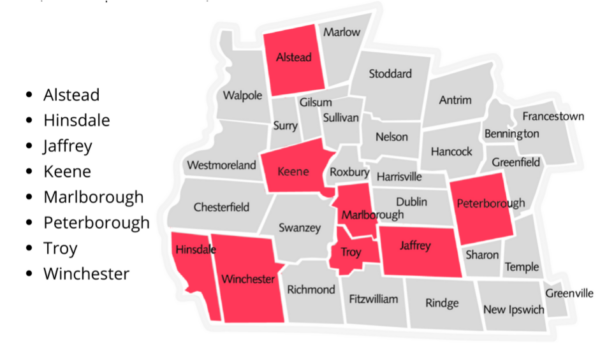
The Coalition is using the Greater Monadnock Region Health Equity Index Guide developed by the Center for Population Health at Cheshire Medical Center to focus its efforts on eight communities out of the 33 in the Monadnock Region. These include Alstead, Hinsdale, Jaffrey, Keene, Marlborough, Peterborough, Troy and Winchester.
These eight communities are considered to have the greatest opportunity for positive impact in the region due to challenges largely associated with non – medical factors that influence health or, social determinants of health.
Establishing Objectives and Key Results
The Coalition held a planning retreat attended by 13 community members in October 2023 and in May of this year it developed their objective and intended key results for the effort. The goal is to accomplish them over the next two years.
Achieving the key results will require setting up youth support cohorts in towns with the greatest opportunity for positive impact (described locally as “high impact towns”). Hansen describes these cohorts as small groups comprised of community members who work with youth experiencing trauma. This includes youth experiencing acute trauma as witnessed by first responders and youth experiencing chronic trauma who may have relationships with therapists, guidance counselors or teachers.
“We’ll get these community members together to have conversations to make sure everybody is aware of everyone else’s experience,” Hansen said. “Then we can start to pin down where the gaps are community by community. Next, we can start devising solutions to bridge these gaps.”
Hansen noted, “There’s been such a positive response in the community and that feels really good. People understand the need and they also are really invested in the solution. Even as early in the process as we are in some ways, there’s already such a feeling of momentum and impact just because of how responsive and supportive our community has been.”
Resources
Trauma Responsive Monadnock website
Monadnock Assembly on Trauma and Transformation website
Greater Monadnock Area Health Equity Index Guide
First update in TRC series: Coos Coalition for Young Children & Families